


Last Updated: November 6, 2026
Quick Summary
Standing at work can increase energy for many people, but the effect is modest. The evidence points to a small lift in alertness and mood rather than a dramatic transformation, and light movement matters more than standing still. Alternating between sitting and standing appears more beneficial than either position for long stretches.
- Start with 30 to 60 minutes of standing at a time and build up gradually.
- In week one, stand for 15 to 20 minutes twice a day.
- Let the task decide your position: calls and admin suit standing, deep focus suits sitting.
- Rate your alertness from 1 to 5 at the start and end of each standing block.
- If your lower back aches or you feel light-headed, sit down.
Table of Contents
- Does Standing at Work Increase Energy? The Short Answer
- What the Research Says About Standing, Alertness and Mood
- How Long to Stand at a Desk: Finding Your Daily Limit
- The Link Between a Standing Desk and Productivity
- Standing Desk Ergonomics: Getting the Setup Right
- Building a Sit-Stand Desk Routine That Fits Your Workday
- When to Sit Down: Reading Discomfort and Fatigue
- Setting Up Your Height-Adjustable Desk
- Frequently Asked Questions
Does Standing at Work Increase Energy? The Short Answer
Yes, standing at work can increase energy for many people, but the effect depends on how you do it. The evidence points to a modest lift in alertness and mood rather than a dramatic transformation. This guide breaks down what the research suggests, where the claims outrun the evidence, and how to build a routine that genuinely works for you.
The honest answer is that standing at work helps some people feel more awake, especially in the early afternoon. It will not fix poor sleep or a bad diet. And standing still for hours brings its own problems.
Below, we explain what the research actually supports, how long to stand, and how to set up a desk so your back and feet thank you.
What the Research Says About Standing, Alertness and Mood
The research on standing at work and energy is promising but limited, and the quality of evidence varies. Most studies are short-term and rely on self-reported alertness rather than objective measures, so treat the findings as encouraging rather than definitive.
What the evidence generally shows:
- Alertness and mood: When people switch from sitting to standing, self-reported energy and mood often improve modestly. The effect is real but small, typically described as feeling less sluggish rather than dramatically energised.
- The sit-stand distinction: The strongest evidence supports reducing total sitting time, not standing endlessly. Alternating between positions appears more beneficial than either sitting or standing for long stretches.
- Movement matters more than posture: Standing still for long periods can leave you just as stiff as sitting. Light movement, shifting your weight, taking a few steps, or pacing on a call, is where the energy benefit lives. Standing alone is not a substitute for regular movement.
- Long-term effects: More high-quality research is needed on sustained standing and health outcomes. Most workplace studies follow participants for weeks or months, not years.
A useful way to think about it: standing is a way to break up sitting, not a cure for fatigue. If you are sceptical, you are right to be. The NHS guidance on sitting less is a sensible starting point for general movement advice, and it reinforces that any position held for too long is worth interrupting.
What most guides miss is the difference between standing still and moving. Standing motionless for long stretches can leave you just as stiff as sitting. Light movement, shifting your weight, or taking a few steps, is where the energy benefit lives. If you want to know whether standing is actually helping you, pay attention to how you feel during and after standing blocks, not just whether you stood.
How Long to Stand at a Desk: Finding Your Daily Limit
There is no single correct number, but a common starting point is 30 to 60 minutes of standing at a time, building up gradually.
The thing nobody tells you about standing desks is that the first week is the hardest. Your feet and lower back will notice the change. Start with short blocks and increase slowly.
A practical way to build up:
- Week one: stand for 15 to 20 minutes, twice a day.
- Week two: extend to 30 minutes per block.
- Week three onward: aim for 45 to 60 minutes, then sit again.
- Always break up long standing with a short walk.
A task-based schedule that works
Rather than watching the clock, let the task decide. Deep focus work suits sitting. Calls, admin and reading suit standing. A realistic pattern for many people looks like this:
| Time block | Position | Best for |
|---|---|---|
| Morning deep work | Sitting | Focused writing and analysis |
| Mid-morning | Standing | Emails, calls, admin |
| After lunch | Standing | Beating the afternoon dip |
| Late afternoon | Sitting | Detailed tasks and review |
This rhythm turns general advice to alternate into something you can actually follow. If you feel a slump coming on, stand up and move for a few minutes before reaching for another coffee.
How to tell whether standing is actually improving your energy
Simple measures help you judge whether standing is working for you:
- Rate your alertness on a simple scale (for example, 1 to 5) at the start and end of each standing block.
- Note how many breaks you take and whether you complete tasks without drifting.
- Pay attention to how you feel an hour after standing, refreshed or drained.
If standing leaves you more tired rather than more alert, shorten the blocks or add more movement. A common pattern is that standing helps most when it replaces a long sitting stretch, not when it is added on top of an already active day.
Discomfort, fatigue and when to sit down
Knowing when to sit is as important as knowing how long to stand. If your lower back aches, your feet throb, or you feel light-headed, sit down. Discomfort is a signal, not a challenge to push through. Prolonged standing carries its own risks, including foot and leg fatigue and lower back strain.
An anti-fatigue mat can help here. The Standing Desk Floor Mat is designed to support your feet and legs during longer standing periods.

Watch out: standing through pain to "toughen up" is the fastest way to give up on your desk altogether. Listen to your body and adjust the duration rather than forcing it.
The Link Between a Standing Desk and Productivity
But here is the catch: productivity claims are often overstated. Standing does not make you work faster. It may help you stay engaged during the mid-afternoon dip.
What the evidence supports:
- Reduced sitting time is linked to better self-reported focus.
- Alternating positions helps break up mental fatigue.
- Movement, not stillness, drives the alertness benefit.
If you want the full picture on how movement affects output, the benefits of standing desks for productivity guide covers the wider evidence and practical habits in more depth.
Standing Desk Ergonomics: Getting the Setup Right
Good ergonomics is the difference between a helpful desk and a painful one. Set your desk height so your elbows sit at roughly 90 degrees, your monitor top is near eye level, and your wrists stay flat. Once your posture is set, brief desk stretches for focus can add movement without undoing the support your workstation provides.
A common mistake is raising the desk too high and hunching your shoulders. That defeats the purpose. Your screen should sit about an arm's length away, with the top of the display just below eye level.
Quick setup checklist:
- Elbows at around 90 degrees when typing.
- Monitor top near eye level, about an arm's length away.
- Feet flat, weight evenly balanced.
- Wrists straight, not bent upward.
- Keyboard close enough that your shoulders relax.
For a detailed walkthrough on getting the height exactly right, see what height should my desk be. It takes the guesswork out of the setup.
Building a Sit-Stand Desk Routine That Fits Your Workday
A sit-stand desk routine works best when it matches your tasks, not a rigid timer. Deep focus work suits sitting. Calls, admin and reading suit standing. Build your day around that rhythm.
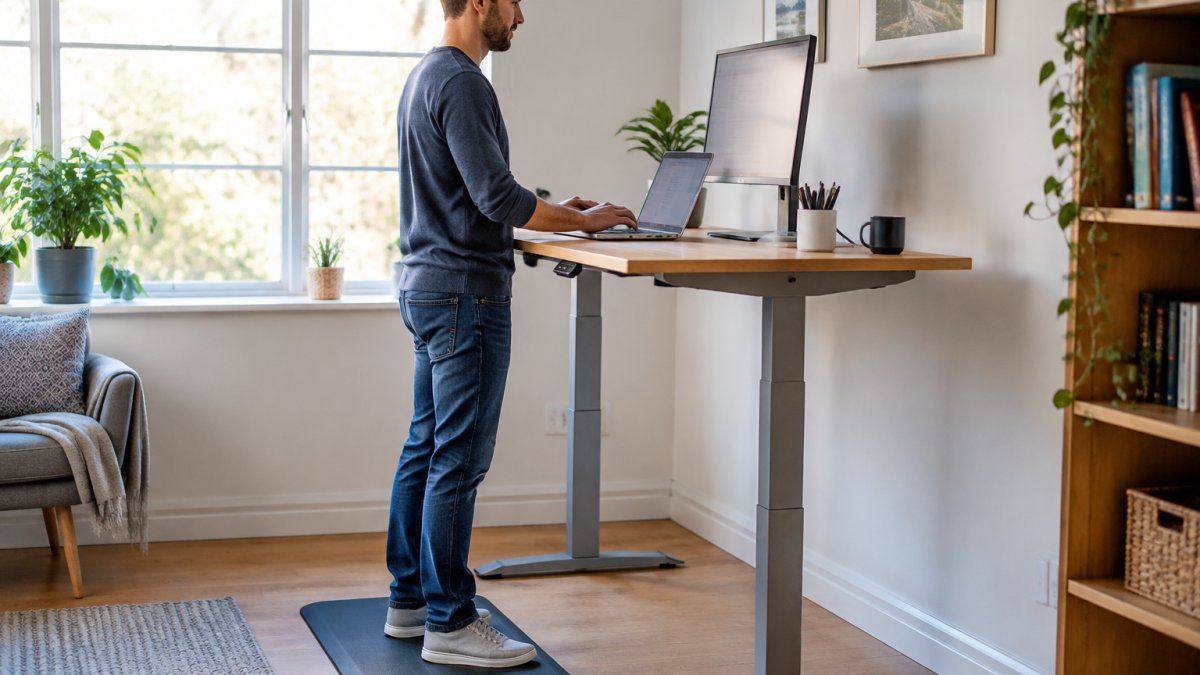
A realistic schedule for many people looks like this:
| Time Block | Position | Best For |
|---|---|---|
| Morning deep work | Sitting | Focused writing and analysis |
| Mid-morning | Standing | Emails, calls, admin |
| After lunch | Standing | Beating the afternoon dip |
| Late afternoon | Sitting | Detailed tasks and review |
The trick is to let the task decide, not the clock. And if you feel a slump coming on, stand up and move for a few minutes before reaching for another coffee.
When to Sit Down: Reading Discomfort and Fatigue
Knowing when to sit is as important as knowing when to stand. If your lower back aches, your feet throb, or you feel light-headed, sit down. Discomfort is a signal, not a challenge to push through.
Prolonged standing carries its own risks, including foot and leg fatigue and lower back strain. The goal is balance, not endurance. Many people find that a comfortable chair makes their sitting periods genuinely restful.
An ergonomic chair helps you recover between standing blocks. The Grace Ergonomic Office Chair is designed to support your posture during those seated stretches, so you return to standing refreshed rather than stiff.

Watch out: standing through pain to "toughen up" is the fastest way to give up on your desk altogether. Listen to your body.
Setting Up Your Height-Adjustable Desk
A height-adjustable desk makes switching positions effortless, which is the whole point. Set two memory presets, one for sitting and one for standing, and switch with a single press.
A common mistake is fiddling with the height every time. Presets remove that friction, and friction is what kills good habits.
When choosing a desk, look for:
- A stable frame that does not wobble at standing height.
- Enough load capacity for your monitor and equipment.
- A height range that suits your body.
- A warranty that reflects build quality.
The Atlas Standing Desk is our flagship model, with a dual-motor system that lifts up to 120kg and a 7-year warranty. If space is tight, the Uno Standing Desk offers a single-motor option for smaller setups, while the Atlas Standing Desk provides a heavier-duty option.

Not sure which suits your setup? You can talk to our friendly team about what product is best for you.
Frequently Asked Questions
Does standing at work increase energy?
The evidence points to a modest lift rather than a dramatic one. Studies on sit-stand working often report small improvements in self-reported energy and alertness, particularly when standing is alternated with sitting rather than used all day. Standing still for long stretches can leave you just as tired as sitting. The benefit comes from changing position regularly, which supports circulation and keeps you more engaged with your tasks. Treat standing as one part of a more active working day, not a standalone fix.
How long should you stand at a desk each day?
There is no single number that suits everyone, but most guidance suggests starting small. Begin with 20 to 30 minutes of standing at a time, a few times a day, and build up gradually over several weeks. Aim to break up long sitting periods rather than hit a daily target. If you feel discomfort in your legs, feet or lower back, sit down and reset. A practical sit-stand desk routine that alternates positions every 30 to 60 minutes tends to work better than standing for hours.
Can a standing desk improve productivity and focus?
Some studies link sit-stand working to small gains in focus and work performance, though results vary and the evidence is not conclusive. The more reliable benefit is reducing prolonged sitting, which is associated with discomfort and fatigue. Productivity gains are most likely when standing is paired with good standing desk ergonomics, such as a monitor at eye level and a mat underfoot. If you are easily distracted, standing during tasks that need alertness, like calls or admin, may help more than standing during deep concentration work.
Is standing all day at work good for you?
No. Prolonged standing carries its own risks, including leg fatigue, foot discomfort and lower back strain. The goal is to avoid long periods in any single position. A sit-stand desk routine that moves you between sitting, standing and short walks is the sensible approach. Use a standing desk floor mat to ease pressure on your feet and legs, and sit down when you notice fatigue building. Alternating positions is what supports energy and comfort across the working day.
Ready to feel more alert at your desk? Ergo Desks has helped home and office workers since 2017, with free delivery and returns and a 7-year warranty on our standing desks. Browse the range and find the height-adjustable desk that fits your space, your body and your working day.

