


Last Updated: 28 October 2026
Quick Summary
The best standing desk alternatives in 2026 are practical ways to break up a day of sitting, and most setups benefit from combining two or three of them. Our guide compares seven options, including a manual crank desk, a standing desk converter, an ergonomic office chair and an under-desk treadmill, so you can match one to your budget, room size and working style.
- The Solo Manual Standing Desk Frame has a height range of 710mm to 1210mm.
- A standing desk converter suits renters and employees who cannot replace their desk.
- The Torvan Ergonomic Mesh Task Chair has a 600mm mesh backrest with twin lumbar pads.
- An under-desk treadmill best suits people with a large home office and a genuine daily step goal.
- Ergo Desks backs its adjustable desks with a seven-year warranty and offers free delivery to mainland UK.
Table of Contents
- Why Standing Desk Alternatives Are Worth Considering in 2026
- Quick Comparison: Standing Desk Alternatives at a Glance
- 1. The Solo Manual Standing Desk: A Crank Alternative to Electric
- 2. The Standing Desk Converter: Keep Your Existing Desk
- 3. The Ergonomic Office Chair: Sit Better Before You Stand More
- 4. The Under-Desk Treadmill: Walking While You Work
- 5. Active Sitting: Movement Without Leaving Your Seat
- How to Choose the Right Alternative for Your Workspace
- Frequently Asked Questions
Why Standing Desk Alternatives Are Worth Considering in 2026
The best standing desk alternatives in 2026 are not a single product. They are a set of practical ways to break up a day of sitting, and most home and office setups benefit from combining two or three of them. This guide from Ergo Desks compares seven options that solve the same problem from different angles, from a manual crank desk to a standing desk converter, an ergonomic office chair and an under-desk treadmill.
Below, each option is covered with its honest strengths and limits, so a decision can be matched to a budget, a room size and a working style. A quick comparison table comes first for anyone who wants the short version.
Quick Comparison: Standing Desk Alternatives at a Glance
Here are seven options, with cost, space, effort to start and who each one suits.
| Option | Typical Cost | Space Needed | Setup Effort | Best For |
|---|---|---|---|---|
| Manual standing desk | £365-£415 | Standard desk footprint | Low | Budget-conscious, eco-minded buyers |
| Standing desk converter | Low | Sits on existing desk | Very low | Renters and fixed desks |
| Ergonomic office chair | £361.67 | Standard chair space | None | Anyone sitting for long stretches |
| Under-desk treadmill | Moderate | Extra floor depth | Moderate | High daily step goals |
| Active sitting stool | Low to moderate | Small | None | Fidgety sitters |
| Anti-fatigue mat | £25-£50 | Under the desk | None | Anyone standing for long periods |
| Walking pad plus desk | Moderate | Combined footprint | Moderate | Full movement-first setups |
1. The Solo Manual Standing Desk: A Crank Alternative to Electric
A manual standing desk is a height-adjustable desk moved by a hand crank rather than a motor. The Solo Manual Standing Desk Frame has a solid steel frame, a smooth rotational crank and a height range of 710mm to 1210mm.

What it gets right is simplicity. The full Solo desk is £415.00, while the frame alone is £365.00.
What works: the crank is quiet, the frame feels planted, and the price undercuts most electric desks.
What doesn't: changing height takes a few seconds of turning, so it suits planned transitions rather than constant fidgeting.
Before buying a crank frame, check which desktops will fit it.
Best for: budget-focused buyers and anyone who wants a desk with no electronics at all. Skip if: you change position many times an hour and want one-touch movement.
2. The Standing Desk Converter: Keep Your Existing Desk
A standing desk converter is a raised platform that sits on top of an existing desk and lifts a keyboard and monitor to standing height.
Best for: renters and employees who cannot replace their desk. Skip if: you run a heavy multi-monitor setup or want a fully clear desk surface.
3. The Ergonomic Office Chair: Sit Better Before You Stand More
An ergonomic office chair is a chair designed to support the lower back and adjust to the user's body.
The Torvan Ergonomic Mesh Task Chair has a 600mm mesh backrest with twin lumbar pads and 80mm of height adjustment, a sliding seat that sets depth from 465mm to 525mm, and 3D armrests. The seat fabric meets UK fire regulations under BS 7176, BS 5852 and EN 1021, and the chair is backed by a five-year guarantee at £361.67.
What works: the synchronised mechanism keeps feet grounded as you recline, and the lumbar support is genuinely adjustable rather than fixed.
What doesn't: it is an investment, and a cheap chair with a cushion will not replicate the adjustment range.
Best for: anyone who sits for long stretches and wants to fix posture at the source. How to alternate sitting and standing at work shows how to combine the two properly. Skip if: you already have a well-fitted chair and only need height variation.
4. The Under-Desk Treadmill: Walking While You Work
Best for: people with a large home office and a genuine daily step goal. Skip if: space is tight or you share a quiet room with colleagues.
5. Active Sitting: Movement Without Leaving Your Seat
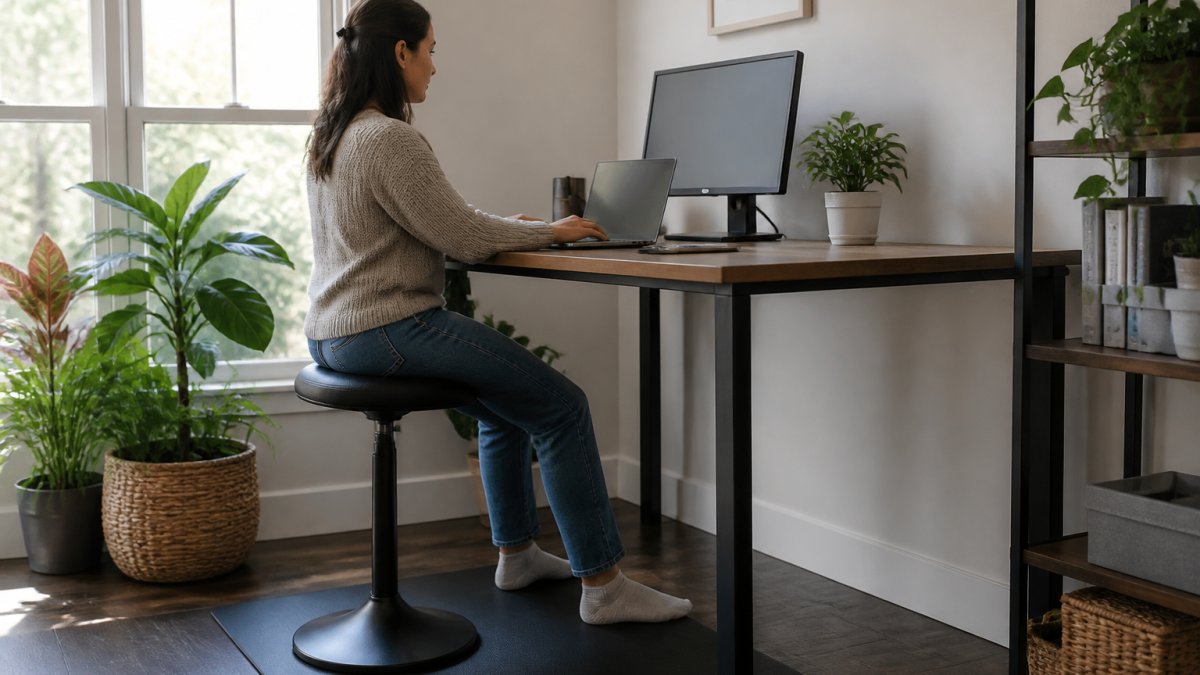
Best for: restless sitters who want movement without a full desk change. Why micro movements matter more than you think explains the benefits of small movements during the day. Skip if: you need firm lumbar support for long, focused sessions.
How to Choose the Right Alternative for Your Workspace
Choosing well comes down to three questions: how much space is available, how much can be spent, and whether the goal is more standing or better sitting. Answer those honestly and the shortlist narrows fast.
Use this checklist to decide:
- Decide whether the priority is standing time or sitting comfort
Anti-fatigue mats are available at £25.00 and £50.00.
Ergo Desks backs its adjustable desks with a seven-year warranty and offers free delivery to mainland UK. If you are still weighing up which route suits your room and routine, talk to our friendly team about what product is best for you.
Frequently Asked Questions
What is the best alternative to a standing desk?
It depends on your space and budget. A mat like the Go Mats standing desk mat at £25 is one available add-on.
Are standing desk converters a good alternative to a standing desk?
A standing desk converter is a raised platform that sits on top of an existing desk and lifts a keyboard and monitor to standing height. The Hybrid Standing Desk is an electric height-adjustable desk.
Can active sitting replace a standing desk?
Active sitting keeps your core engaged and encourages small movements, but it does not give you the postural change that standing provides. Think of it as a complement rather than a replacement. The most ergonomic approach is to rotate between sitting, active sitting and standing through the day, changing position roughly every 30 to 45 minutes so no single posture dominates.
How often should you change position while working at a desk?
Aim to change posture every 30 to 45 minutes rather than standing all day. Standing for hours without a break brings its own discomfort, so alternate between sitting, standing and short walks. An under-desk treadmill or a standing desk mat helps make those transitions easier, and a desk with preset height memory, such as the Atlas Mini Sit Stand Desk, makes switching quick enough that you actually do it.
The real challenge is not finding an alternative to a standing desk. It is building a working day that keeps a body moving without disrupting focus. Ergo Desks specialises in height-adjustable standing desks and ergonomic accessories, backed by a seven-year warranty, free delivery to mainland UK and tailored corporate solutions with bulk discounts and assembly for larger teams. Get started with Ergo Desks and build a workspace that supports how you actually work.

